
A veteran designer’s guide to surviving yet another apocalypse
If you’ve been in design for three decades or more, you’ve probably noticed a pattern by now. Every few years, someone discovers that the sky is falling, design is dead, and we’re all about to be replaced by [insert revolutionary technology here]. The panic is always genuine, the hand-wringing always sincere, and the predictions of doom always… well, let’s just say they age about as well as a 1990s website viewed on a modern browser.
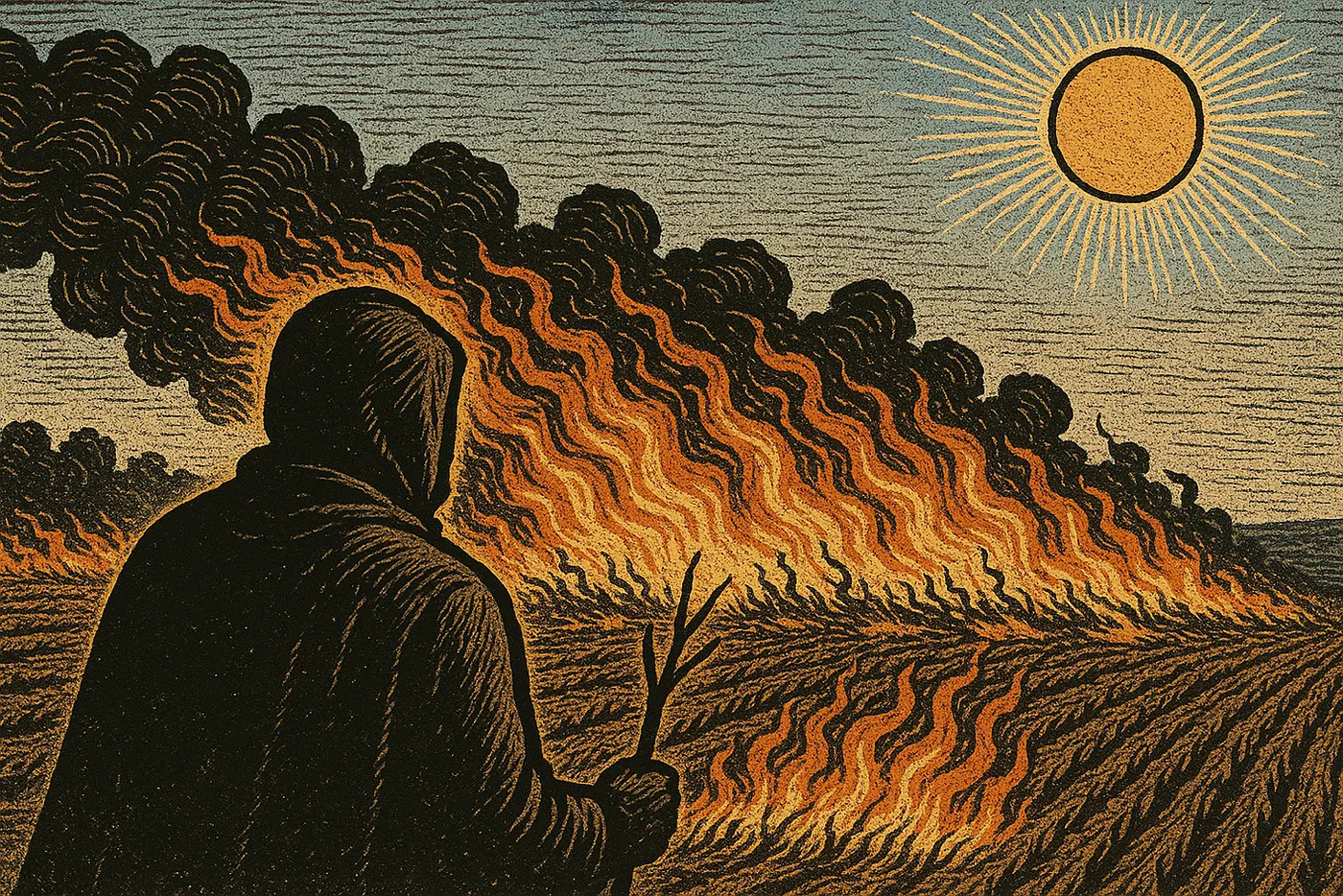
Here’s what I’ve learned after watching the design world burn down and rebuild itself multiple times: it’s not destruction, it’s agriculture. Think controlled burning, periodically torching the field to make the soil more fertile. Sure, it looks dramatic while it’s happening, but that’s how you get the good stuff to grow.
Each time, the same cycle plays out: initial panic, gradual adaptation, and eventual realization that we’ve just been promoted to a more interesting job. Let me walk you through the fires I’ve survived, with the benefit of hindsight and a healthy dose of perspective.
The First Burning: When Computers Stole Our Paintbrushes (1980s–1990s)
The Great Hand Tool Extinction Event
Picture this: I’m in college, hunched over a drafting table, carefully painting letterforms with a paintbrush and plaka paint for a typography assignment. My professor, Dietmar Winkler, watches us labor over each stroke and casually mentions, “Everything I’m teaching you will be obsolete next year.”
Thanks for the pep talk, Professor.
But then he added the kicker: “You need to know this so you’ll understand where the next phase gets its foundation. Master these fundamentals, and you’ll be able to direct the new media to heights that others can’t even dream of.”
At the time, it felt like we were learning to forge horseshoes just as the Model T was rolling off the assembly line. The desktop publishing revolution was indeed making our carefully cultivated hand skills about as relevant as knowing how to properly maintain a Linotype machine.
But here’s what made Winkler remarkable: despite his classical training, he was genuinely excited about the emerging digital design medium. This wasn’t a professor grudgingly acknowledging technological inevitability. This was someone who understood that mastering traditional techniques AND grasping the new opportunities with both hands was the path forward. He embodied exactly the approach he was teaching us: deep respect for foundational knowledge coupled with enthusiastic embrace of transformative new possibilities.
The Digital Revolution of the Early-Mid ’90s
While the technology had been brewing since the mid-80s, the real paradigm shift hit in the early-to-mid ’90s, right alongside grunge music, indie culture, and that whole DIY counterculture moment. It wasn’t just coincidence; desktop publishing democratized design in ways that perfectly aligned with the era’s anti-establishment, do-it-yourself ethos.
The design world went through its first major identity crisis. Seasoned designers watched their painstakingly developed skills, ruling pen technique, photo retouching with actual brushes, the dark arts of paste-up, become as useful as knowing how to sharpen a quill. Many predicted the end of “real” design, the death of craftsmanship, the triumph of soulless technology.
Meanwhile, designers like David Carson were taking these new digital tools and pushing the publishing medium way beyond its traditional bounds. His work on Raygun magazine synthesized journalism with digital presentation in ways that sometimes ventured into abstract art territory more than conventional publishing. Carson wasn’t mourning the death of “real” design. He was using digital tools to create work that was more experimental, more expressive, and more boundary-breaking than traditional methods could ever achieve.
Meanwhile, those of us who dove headfirst into Photoshop and QuarkXPress discovered something wonderful: we could think bigger. When you’re not spending three hours ruling perfect lines by hand, your brain has time to consider more sophisticated visual concepts. The undo button alone was like discovering fire.
But the real revelation was that digital tools weren’t just replacing analog ones. They were opening up entirely new creative frontiers. 3D modeling software suddenly made it possible to create impossible objects and spaces that existed only in imagination. Digital video production meant motion graphics and effects that would have required massive film budgets were now accessible to anyone with a computer and enough patience to wait for renders.
The Unexpected Promotion
What we didn’t realize at the time was that we weren’t losing our jobs. We were getting promoted from production artists to conceptual thinkers. The technology didn’t replace creativity; it just cleared away the tedious parts so we could focus on the interesting bits.
Winkler was right. Those brutal hours painting letters taught us about letterform anatomy, spatial relationships, and visual rhythm in ways that would prove invaluable when directing digital typography. We weren’t just users of the new tools. We were informed users who could push them in directions their creators never imagined.
The Second Burning: When the Web Ate Print (1990s–2000s)
Goodbye, CMYK. Hello, 72 DPI Chaos.
Just as we’d gotten comfortable with desktop publishing, along came the World Wide Web to upend everything again. Suddenly, our beautiful, predictable print world, with its reliable color reproduction and fixed dimensions, was replaced by the digital Wild West of multiple browsers, screen sizes, and the infamous “web-safe color palette.”
If you thought the transition from hand tools to computers was dramatic, try explaining to a print designer in 1995 why their carefully crafted layouts need to work on both a 640×480 monitor and… well, that was pretty much it back then. The web was like being asked to design for a medium that couldn’t make up its mind about anything.
Enter Jakob Nielsen, Unlikely Hero
This is where understanding foundations became crucial again. Jakob Nielsen wasn’t inventing web usability principles out of thin air. He was applying decades of human-machine interaction research to a new medium. His seemingly obvious insights about navigation, readability, and user behavior were actually deep knowledge of human psychology applied to screens instead of control panels.
Designers who understood these underlying principles could unlock the web’s potential in ways that purely aesthetic-focused designers couldn’t. They weren’t just making things look pretty online. They were creating functional, user-centered experiences that actually worked.
(Full confession: when I first read Nielsen’s Designing Web Usability: The Practice of Simplicity, I 100% didn’t agree with it. The aesthetic movement was everything! Who needed his boring usability guidelines? But within a few years, as the purely aesthetic approach crashed and burned in the real world of actual users trying to accomplish actual tasks, I had to repent hardcore. I was wrong. Very wrong. And with that humility came the ability to actually utilize his work. Turns out it’s much easier to learn from someone when you’re not busy being defensive about your own aesthetic superiority.)
The Medium as the Message (Again)
The web didn’t just digitize print design. It invented entirely new forms of communication. Hypertext, real-time updates, user interaction, global publishing… these weren’t just features, they were entirely new creative possibilities. We went from designing objects to designing experiences, from static compositions to dynamic systems.
Sure, we lost pixel-perfect control and color accuracy. But we gained something far more interesting: the ability to create design that responded, adapted, and evolved in real-time.
The Third Burning: When AI Crashed the Party (2020s–Present)
The Current Panic Attack
And here we are again, watching the design community work itself into a familiar frenzy. “AI will replace all designers!” “Creativity is dead!” “Anyone can make professional-looking designs now!”
Deep breath, everyone. We’ve been here before.
Yes, AI can now generate illustrations faster than you can say “trending on Dribbble.” Yes, it can write copy, suggest color palettes, and even create entire brand identities in the time it takes you to open Illustrator. But before we all update our LinkedIn profiles to “Former Designer, Current Existential Crisis Specialist,” let’s apply some historical perspective.
The Democratization “Threat”
Every paradigm shift brings the same complaint: “Now anyone can do what we do!”
Well, yes. Anyone could also use QuarkXPress in 1990. Anyone could build a website in 2000. Funny how the world still needed good designers.
The democratization of tools has never been the threat. It’s been the opportunity. When more people have access to creative tools, the bar for what constitutes good design actually goes up, not down. Amateur Hour just got a lot more crowded, which makes professional-level thinking more valuable, not less.
The AI Acceleration
What AI is really doing is the same thing every previous technology did: handling the routine stuff so we can focus on the conceptual work. Need 50 variations on a logo concept? AI’s got you covered. Want to explore color palettes based on obscure 1970s Soviet textile patterns? Ask ChatGPT to generate them while you think about brand strategy.
The technology isn’t replacing human creativity. It’s amplifying it and accelerating the iteration process. We’re getting promoted again, from pixel-pushers to creative directors, from executors to visionaries.
Foundation Knowledge Strikes Again
Here’s where those fundamentals matter once more. Understanding composition, color theory, typography, and user psychology doesn’t become irrelevant when AI enters the picture. It becomes essential for directing AI effectively.
Take my friend Jeremy Grassman, who spent years as a design instructor before becoming one of the most skilled AI image manipulators I know. He’s making AI dance a fine ballet across Midjourney, Photoshop, and every other tool with an AI agent. Jeremy isn’t just typing “make it cool” into a prompt box. He’s applying decades of visual knowledge to create consistent imagery and impossible worlds that exist only in digital space. He’s essentially become a design mentor to his AI student, and that mentorship is only possible because of his deep foundational knowledge.
The Pattern: Creative Destruction as Career Development
Looking back across these three shifts, the pattern is almost comically consistent:
- New technology emerges
- Everyone panics about obsolescence
- Some people resist, others adapt
- The adapters discover new creative possibilities
- The resistant become irrelevant
- Rinse and repeat in 10–15 years
Each “apocalypse” has actually been a promotion in disguise. We’ve moved up the creative hierarchy from craft execution to conceptual direction, from technical skill to strategic thinking, from making things to making meaningful things.
The Field-Burning Advantage
If you’ve been through this cycle a few times, you have a significant advantage: you know the drill. You understand that the initial disruption always feels existential but usually leads somewhere more interesting. You’ve learned to see past the immediate chaos to the emerging possibilities.
More importantly, you’ve developed the most valuable skill of all: the ability to apply fundamental design principles to completely new contexts. Whether you’re painting letters with plaka, directing pixels in Photoshop, crafting user experiences for the web, or collaborating with AI, the underlying knowledge of what makes visual communication effective remains remarkably constant.
Advice for the Next Burning
When the next paradigm shift arrives, and it will, remember:
Don’t panic. The sky has been falling for 40 years. We’re still here.
Don’t resist. Every previous generation of designers who insisted the old way was better got left behind.
Do explore. The people who shape new paradigms are the ones who start experimenting early, while the tools are still rough and the possibilities unclear.
Do remember your foundations. Technical skills become obsolete. Design principles endure.
Do help direct the change. You’re not just adapting to new technology. You’re helping determine how it gets used.
The Promotion Continues
Each technological shift has been, ultimately, a liberation. We’ve been freed from increasingly mundane tasks to focus on increasingly interesting problems. The future belongs to designers who understand that their value isn’t in their ability to operate specific software, but in their capacity to think strategically, solve complex problems, and create meaningful human experiences.
It’s worth noting that “apocalypse” originally meant “revelation” or “unveiling”, not destruction. Each of these design “apocalypses” has revealed new creative territories that were previously impossible to access. Maybe we’ve been using the right word all along, just with the wrong understanding.
So the next time someone announces that AI (or quantum computing, or brain-computer interfaces, or whatever comes next) will replace designers, just smile knowingly. You’ve heard this song before. You know how it ends.
The field is burning again. Time to plant something new.
After three decades and three paradigm shifts, I’ve learned that the only constant in design is change, and that’s exactly what makes it interesting. The apocalypse is always next year. The opportunities are always right now.
A Note on Collaboration
Speaking of AI partnerships, I should mention that I worked with Claude to create this article. Claude didn’t write it. I did. But Claude helped refine my raw thoughts into something you’d actually want to read, taking heavy direction and insight from me throughout the process. Think of it like the scribes who worked with apostles like Paul or Peter in Scripture. They weren’t the authors, but they helped transform spoken ideas into readable text.
It’s a fitting example of exactly what I’ve been arguing: AI as a collaborative tool that amplifies human thinking rather than replacing it. The ideas, experiences, and perspective are mine. Claude just helped me present them more clearly. Which is precisely the kind of creative partnership that defines this third paradigm shift.