
Format: Operating model
UX as Organizational Strategy
How I repositioned design from a delivery function into a product-shaping force at Arcos, and what the efficiency revealed
Arcos had never had a UX function, and product decisions, including a Timesheet attempt that shipped and missed, were made without grounding in user reality.
- My part
- I built the UX function and its working model: hired three Senior Designers and gave each a domain, used draft screens and coded prototypes to shape scope with receptive and resistant pods alike, and built the design-system pipeline that freed time for shaping.
- The team’s part
- Ales Karoza, Oswaldo Vazquez, and Alina Shaulinskaya owned their domains; Oswaldo and Ales built the coded prototypes in theirs. Erin Gold, a Slalom consultant, carried user-flow strategy and the back office. Product and Engineering held the rollover cap by renegotiating scope, and the mobile pod built its own UX Designer agent.
- Status
- Internal
- Timeline
- Oct 2024 – Jul 2026
Outcome
UX shaped product scope before engineering began, not just how things looked once specs arrived
Tags & related work
The short version
Diagnose
Arcos had never had a UX function. The CPO hired me to build one, and I found ambiguity rather than hostility: some pods saw UX as polish applied after the real decisions. UX was me plus one consultant, Erin Gold from Slalom, receiving specs and working on how things looked. An earlier Timesheet attempt, built before UX existed, had shipped and missed. By my own count, UX touched about three initiatives a quarter.
Before: UX received specs and worked on how things looked. By my own count it touched about three initiatives a quarter. Grow
I hired three Senior Designers and gave each a domain by skillset. Ales Karoza owned field and mobile, Oswaldo Vazquez workforce management and command-center flows, Alina Shaulinskaya the Clearion tool. Erin Gold, a consultant, carried user-flow strategy. Two weeks of training in March 2026 moved all three designers into VS Code with Claude Code CLI. All three, plus one original consultant, were still at Arcos after I left.
The team grew from one designer plus one consultant to three Senior Designers and a consultant, and it outlasted my time there. Earn
With resistant pods I listened first, then negotiated: define the ideal experience, agree on a release better than today. In January 2025, rough draft screens I drew turned circular scoping into triage within weeks. AI-minded engineers became advocates; skeptics still doubted UX-produced code when I left. Across three piloted Control Tower cycles, a three-day kickoff replaced a two-week investigation sprint. The remaining team later reported kickoff took Monday plus part of Tuesday.
Kickoff went from a two-week investigation sprint to three days. The team reported later that it took Monday and part of Tuesday, with Design and Product presenting scope and specs. Test
For Timecards, a capability Arcos had already missed once, I joined objective-setting, aggregated user data with AI, and built proofs of concept in Lovable. A coded prototype reached roughly 400 field users at the Linemen’s Rodeo before the Outcomes phase began, and initial outcomes were ready by week 3. Testing moved logging from hour type to pay type. Timecards shipped in beta in June 2026 and reached production that September, after I left.
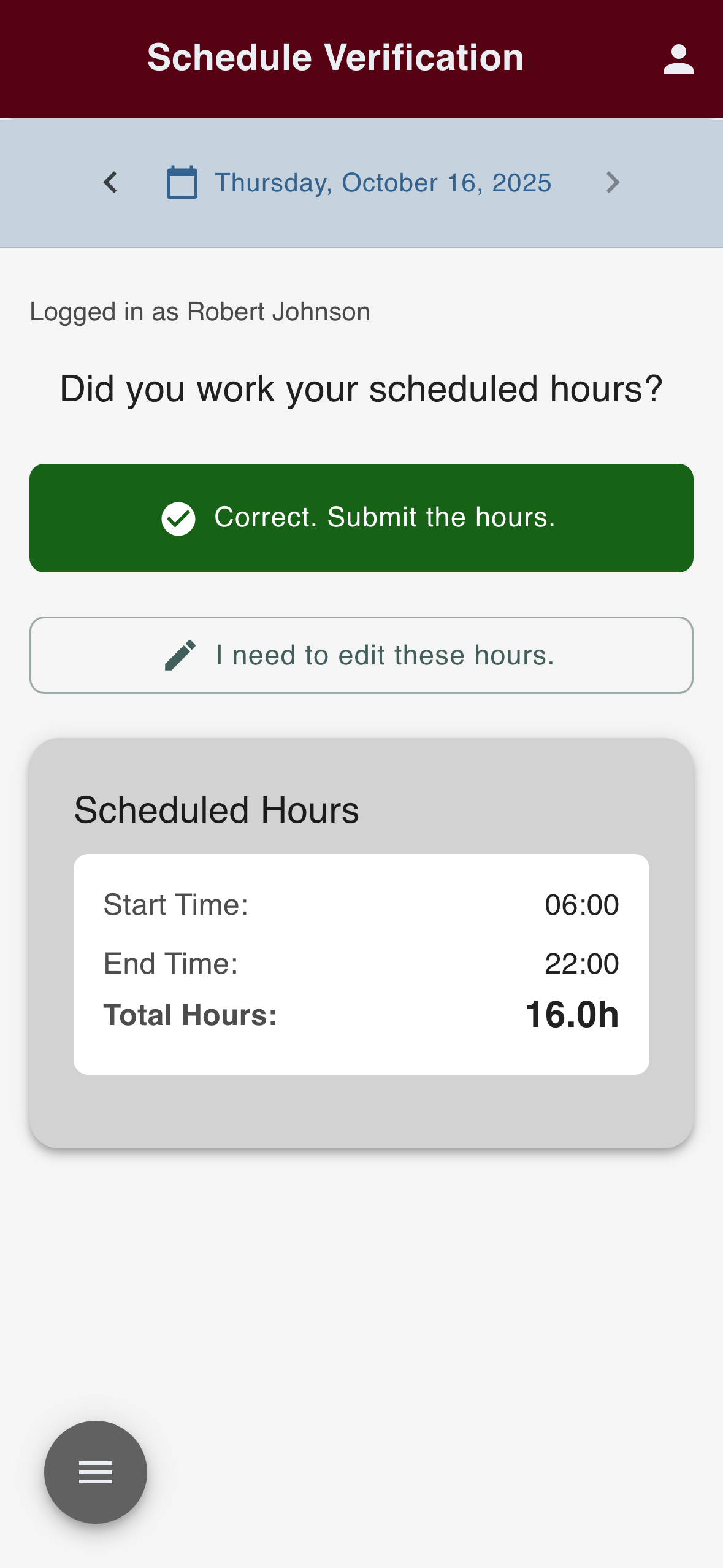
- Mark 1, on the convention floor: one person
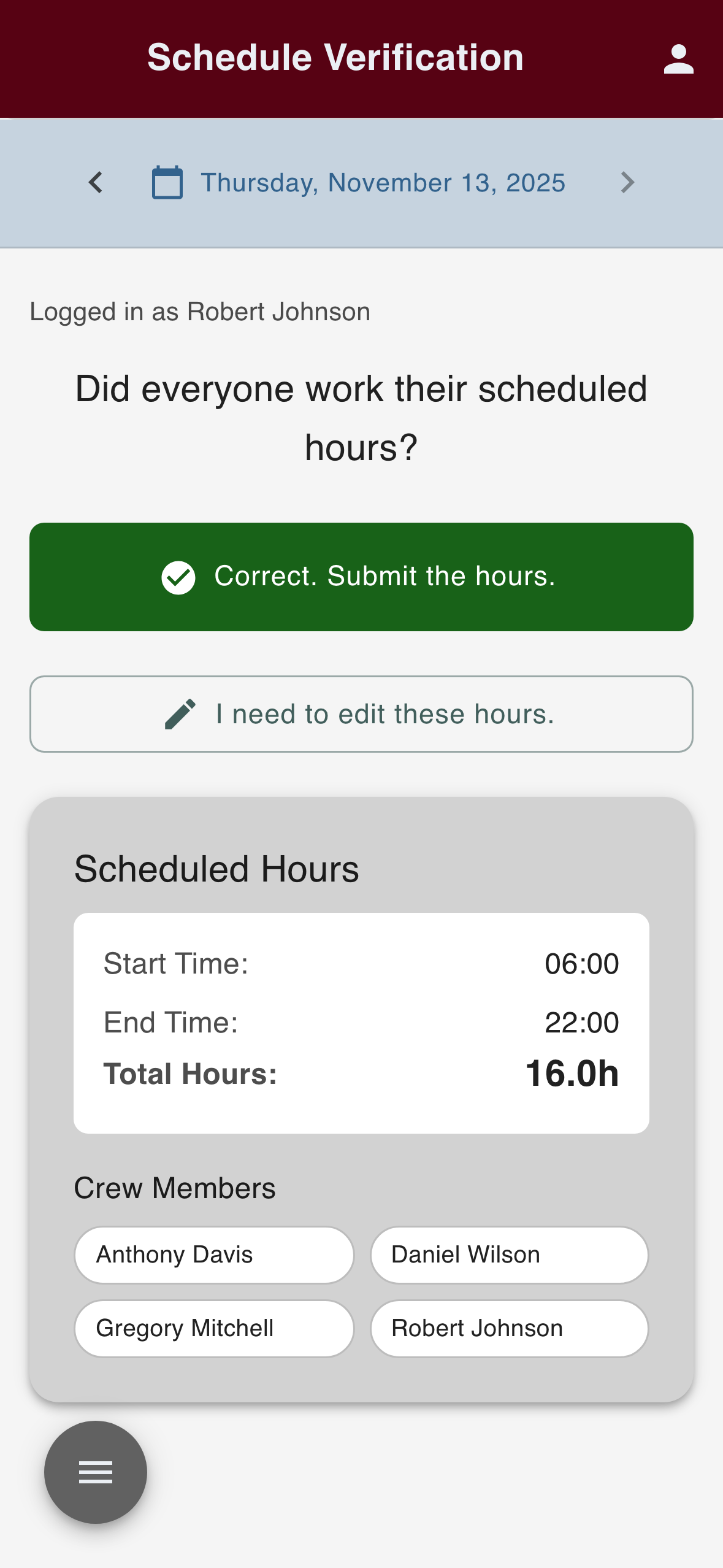
- Mark 2.1: one entry for the crew
Mark 1, the coded Mobile Timecards prototype I took to the Linemen’s Rodeo, where roughly 400 field users tried it, and Mark 2.1, the crew-entry build I made at Arcos after the Rodeo. These are original captures; the separately linked public Mark 2 demo in the Timecards study is my post-departure reconstruction. Arcos’s 20-member Storm Response Advisory Committee took part too. Measure
The delivery pipeline recovered half a sprint to a full sprint per six-week cycle. UI stories that pointed at 5–8 came back as 1–3, and a rebrand with light mode took one week instead of two. Rollover, which could swallow a whole cycle, was capped near 20%; past that, Product and Engineering renegotiated scope. The figures come from my observation and Product’s reports to executives, not instrumented analytics.
Before Shape Up, rollover could consume a whole six-week cycle. Under Shape Up it was capped near 20%, and Product and Engineering had to renegotiate scope if it was likely to go over. Reveal
The recovered time showed where design’s real work was. Engineering’s spare hours went to platform support and tech debt, not new screens. Designers reaching delivery-ready in about two and a half days spent the gain shaping the next outcome. The remaining ambiguity sat upstream, in purpose and the shape of the data. I left in the second week of the new four-week, engineer-owned cycle, so my account stops there.
Where the recovered time went: engineering’s into platform health, design’s upstream into shaping. My own estimates, not instrumented analytics.
Decisions that mattered
Decision 1
How should UX earn a voice with pods that doubted it?
- Options
- Choice
- Earn it with each pod on its own terms: listen first, then negotiate the release
- Evidence
- Resistant pods had real constraints UX didn’t know by default: tech-stack debt and timeline pressure. Some saw UX as a polish layer; others doubted a central team could understand their stack.
- What followed
- By my own count, engagement grew from one initiative each in three pods to active work in four. Some skeptics were still skeptical when I left.
Decision 2
What do you put in front of a room that keeps circling scope?
- Options
- Choice
- Show rough, explicitly aspirational draft screens now
- Evidence
- Pointing at something wrong is easier than defining something right, and the architects and product managers had no concrete artifact to react to.
- What followed
- Within weeks, scoping turned into focused triage, and draft screens first became a repeatable method, including the Timecards proofs of concept.
Decision 3
How should three Senior Designers cover two products and several pods?
- Options
- Choice
- Give each designer a domain, assigned by skillset
- Evidence
- I had hired for different strengths: research at a systems level, direct work with engineering constraints, and holding a long-term vision while negotiating a release.
- What followed
- Ownership set who built which prototypes: Oswaldo built Roster’s from Erin’s and product management’s requirements, and Ales designed Roster’s React Native mobile surface in Figma Design against the Harmony Mobile theme.
What I’d do differently
I underestimated how long some resistant pods would take to come around. I’d have been more patient early, and more explicit about keeping the long-term vision in writing, so the north star survived leadership changes and fading memories. With engineers who doubted UX-produced code, I’d have led with output from the start, because showing it was the only thing that moved that conversation.
Results
- Control Tower platform directionDraft screens reframed the product vision in January 2025EA and PM teams moved from circular scoping to focused triage in weeks
- Timecards capabilityPOC-first approach shipped as Timecards Mobile and Timecards ManagementTested with roughly 400 field users at a convention and Arcos’s 20-member Storm Response Advisory Committee; shipped June 2026 in beta, then reached production in September 2026, after I left. Outcomes-phase shaping for this capability compressed from a routine 6-week cycle to initial outcomes ready by week 3 (self-reported, single named example)
- Team built outlasted my tenureAll 3 designers I hired, plus one of the original consultants, were still at ArcosSelf-reported, from my last conversation with the team, August 2026
- Sprint recovery½–1 sprintPer milestone cycle within a 6-week cadence, across three piloted Control Tower cycles (my observation and Product management’s reports)
- Story point shift5–8 → 1–3Fibonacci UI estimates as the design system’s token layer matured
- Rebrand + light mode1 wkDown from a full 2-week sprint
- Rollover rateFull cycle → ≤20%Capped under Shape Up by a Product/Engineering scope-renegotiation trigger
Read the full story8 min
What I walked into
When I joined Arcos, the company had never had a formal UX function. The CPO wanted a strong UX voice that would ask uncomfortable questions and unify a product suite across emergency and normal operations, very different personas, and tools that had grown through acquisition.
What I found wasn’t hostility. It was ambiguity about what UX was for. Some pods saw it as a visual polish layer, applied after the real decisions had been made. Others doubted a central UX team could understand the technical constraints they lived with. UX was one designer, me, plus one consultant, Erin Gold from Slalom. By my own count it touched about three initiatives a quarter: one each in Arcos Control Tower; Clearion, a vegetation management tool Arcos acquired in October 2024; and Mobile Workbench.
Arcos had made real, shipped product decisions without grounding them in user reality. The clearest proof was an earlier attempt at a Timesheet capability, built before UX existed, that shipped and missed. Handled carefully, that memory could become an argument for working differently.
Something to push back on
In January 2025 the Enterprise Architects and Product Managers shaping Arcos Control Tower and Arcos Field were going in circles. We had service blueprints, personas, and early research synthesis, but nothing concrete enough to anchor a room of people who think in systems and specifications. I took the thin slice of requirements we had and drew draft screens to present my user-lenses vision to the design team and product leadership: not polished, not validated, explicitly aspirational. They were the start of the user lenses in the Control Tower study.
The bet was that pointing at something wrong is easier than defining something right. Within weeks the conversation moved from open-ended scoping to focused triage. Engineers could say a workflow wouldn’t work with their stack; architects could see seams before they reached a spec. The screens didn’t answer the question. They changed which question the room was asking.
With resistant pods, process came second. Listening came first: sitting in on engineering conversations I didn’t have to attend and asking what made their problems hard. UX defined the ideal experience; then the pod and I negotiated toward a release that was meaningfully better than the current state, even when it wasn’t the full vision. A strong, honest relationship with a tech team is worth more than one perfect release.
A team that owned its domains
UX started as one designer plus one consultant and grew to three Senior Designers and one consultant, because the work across Control Tower, Arcos Field, and Timesheet needed it. I hired for a specific mix: research at a systems level, direct engagement with engineering constraints, and the ability to hold a long-term vision while negotiating a release. Ownership went by skillset rather than spreading everyone across everything. Ales Karoza owned field and mobile experiences, including login. Oswaldo Vazquez owned workforce management, command-center flows, and the heaviest data visualizations. Alina Shaulinskaya owned the Clearion tool, mapped to work order management and workflow. Erin Gold, our consultant, carried user-flow strategy and back-office data.
Coded prototypes followed the same lines. Oswaldo built the Roster feature’s prototypes once he had requirements from Erin and product management and a couple of rounds of Figma ideation. Ales built most of his in Figma Make, but Roster’s mobile surface ran on React Native, which didn’t suit in-tool coded prototyping, so that work happened in Figma Design against the Harmony Mobile theme and went to Zeplin. In March 2026, two weeks of training and environment setup moved all three senior designers into VS Code with Claude Code CLI.
Earning the Timecards milestone
By August 2025 that credibility was buying access. The Timesheet capability, later shipped as Timecards, was the feature Arcos had already tried and missed, and I pressed to be involved at objective-setting rather than after it. Leadership agreed, not because policy required it, but because the alternative had a known outcome. I used AI to aggregate the user and customer data we had, surface the threads with the most value, and quickly build working proofs of concept in Lovable, so bad ideas died before they cost engineering time.
A coded Mobile Timecards prototype existed midway through the Milestones phase. It went to the convention floor at the Linemen’s Rodeo, where roughly 400 field users gave live feedback before the Outcomes phase had started, and Arcos’s 20-member Storm Response Advisory Committee reviewed it too. Outcomes-phase shaping, which had routinely run the full six weeks, had initial outcomes ready for validation by week 3. That happened once, on Mobile Timecards; it is not a measured average.
Testing changed the build, too. Before the delivery pipeline existed, the only initiative tested end to end was convoy tracking, with Storm Response Advisory Committee leaders and internal Customer Success users, and testing stopped once its scope was cut to creating and tracking a convoy. Login (mobile and back office) was never tested with users. Neither was the first AI expense agent, a hackathon proof of concept with no design involvement; the version I designed later was tested internally and with the advisory committee. Once the pipeline was running, coded prototypes were tested with users for Roster Requests, Roster Response, Timecards Mobile, Timecards Backoffice, and Demobilization. On Timecards Mobile, storm-response users said the kind of hours they logged (travel, idle, working, resting) mattered less than role level and pay type (regular, overtime, doubletime), so logging moved to match. Timecards Mobile and Timecards Management shipped in June 2026, in beta, and reached production in September 2026, after I left.
What the efficiency revealed
The delivery pipeline itself, a design-system npm package I built plus Figma, Zeplin, and Storybook MCPs and Claude Code, is told in The Handoff Is the Bug.
Across three piloted Arcos Control Tower cycles, by my own observation and Product management’s reports to executives, a three-day Shape Up Delivery Kickoff replaced a two-week investigation sprint. Half a sprint to a full sprint came back on each six-week milestone cycle. UI stories that had pointed at 5–8 came back as 1–3 on the Fibonacci scale as the token layer matured. A rebrand with light mode, which would have taken a two-week sprint, took one week.
The recovered time went to different places on each side. Assuming a 65-hour per-person sprint, front-end delivery started reaching cycle goals in about 30 hours, helped by a shift to one engineer owning one outcome instead of a whole pod sharing it. The other 35 hours went to platform support, backend stories, overflow from earlier cycles, and tech debt. Design capacity moved upstream. Once a designer could take a concept to delivery-ready in roughly two and a half days, the freed time went into shaping the next iteration’s outcomes, carrying what the last one taught straight into it.
The efficiency showed something the original hypothesis hadn’t accounted for. The remaining ambiguity wasn’t in the handoff. It sat earlier: in whether the purpose behind a layout decision had ever been made explicit, and whether the shape of the data matched what a user needed to see. Oracle’s Redwood Design System names both: Clarity of Purpose and the shape of the data. The smarter the agents got, the more plainly they showed how much that grounding mattered.
Then the mobile pod showed what documentation is for. They had connected the Zeplin MCP to a Claude Code workflow, and they had built a UX Designer agent of their own, trained on the ways-of-working documentation my team had published. Nobody asked them to. The documentation made it possible because it gave the reason a thing is done, not only the rule.
Rollover shows the operating-model side. Before Shape Up, unfinished work could consume an entire six-week cycle, with no room for anything new. Shape Up capped rollover near 20%, and the cap had a real mechanism: if projected rollover looked likely to pass it, Product and Engineering had to meet and agree on a new scope before work continued. In late April 2026, leadership agreed to retire the formal Milestone and Shaping phases for a shorter planning cadence, betting on what one engineer could own across four weeks rather than what a pod could commit to across six. May and June went to cleaning up before the first cycle began.
Early, and honest about it
I left in the second week of the first four-week, engineer-owned cycle, after one kickoff, so this account stops there. By then, designers were no longer the primary producers of UI in Figma. They had become reviewers, checking that what got built held to the upstream UX decisions, that accessibility hadn’t been traded away, and that what reached user acceptance testing was something the design team could stand behind.
The engineering side wasn’t settled either. AI-minded engineers were invested advocates, and the Zeplin MCP had real traction with them. Engineers skeptical of AI tended to feel UX couldn’t produce trustworthy code without formal engineering training, a reasonable position I didn’t try to argue past. Showing output before pitching the model was the only thing that moved it, and by the time I left, the conversation with Tech leadership had shifted from whether UX should produce code to what the review and merge process should look like.
By my own count, UX went from about three initiatives a quarter to active work in four pods: two in Control Tower, one in Clearion, one in Mobile Workbench. It is a before and after, not a share of all pods. The pace figures rest on my observation and Product’s reports to executives; the pod counts and capacity figures are my own estimates. None of it is instrumented analytics.
Some of it outlasted me. After my time at Arcos ended, the remaining team reported that across two six-week iterations, kickoff took Monday plus part of Tuesday, with Design and Product presenting scope and specs. That is their account, not something I measured. All three designers I hired, plus one of the original consultants, were still at Arcos at my last conversation with them in August 2026, and they named AI-assisted design delivery, a refined research framework, and design-system expansion as what came next.
The thing that existed at the end that didn’t before isn’t a screen. It’s a position: UX shaped product scope before engineering began, not just how things looked once specs arrived.
Team
- 3 Senior Designers
- 1 consultant, Erin Gold, Slalom (built from 1 designer + 1 consultant)
Agent view
This page has a machine-readable twin, generated from the same source rather than written alongside it.
See how an agent reads this page