
Organizational strategy, in three stops
Three case studies chosen for how they show cross-functional alignment and organizational-level strategy — including where buy-in was partial, not just where it succeeded.
Start here. There was no UX function at Arcos before I built the credibility, process, and relationships to make one exist.
Arcos, IncArcos had no UX function before I arrived. Credibility, process, and relationships are what made design a necessary voice in what gets built, not just how it looks.
Arcos had tried to build a Timesheet capability once before UX existed, and it missed. The second attempt was shaped with aggregated user data and POCs tested against roughly 400 field users before engineering committed, and it shipped. That shift, from receiving specs to shaping scope, is what two years of earning credibility with resistant and receptive engineering pods alike actually bought.
That credibility bought room to build: scaling from one designer to four, and standing up an AI-assisted delivery model that changed what the function could take on.
Arcos, Inc. UX Leadership & AI DeliveryWhat an AI-assisted delivery model revealed about where design creates its highest value, and why speed without clarity of purpose just accelerates the wrong thing.
When the delivery pipeline started working, the recovered capacity had to go somewhere. This is the story of what the efficiency revealed: the upstream problem of purpose, data shape, and user intent is harder and more valuable than the downstream one. And what it means when your team’s documented ways of working become the training set for an AI agent someone else built.
This is the honest version: a cross-functional headcount argument made with no direct authority, and a governance model that’s still earning buy-in, not one that landed cleanly on day one.
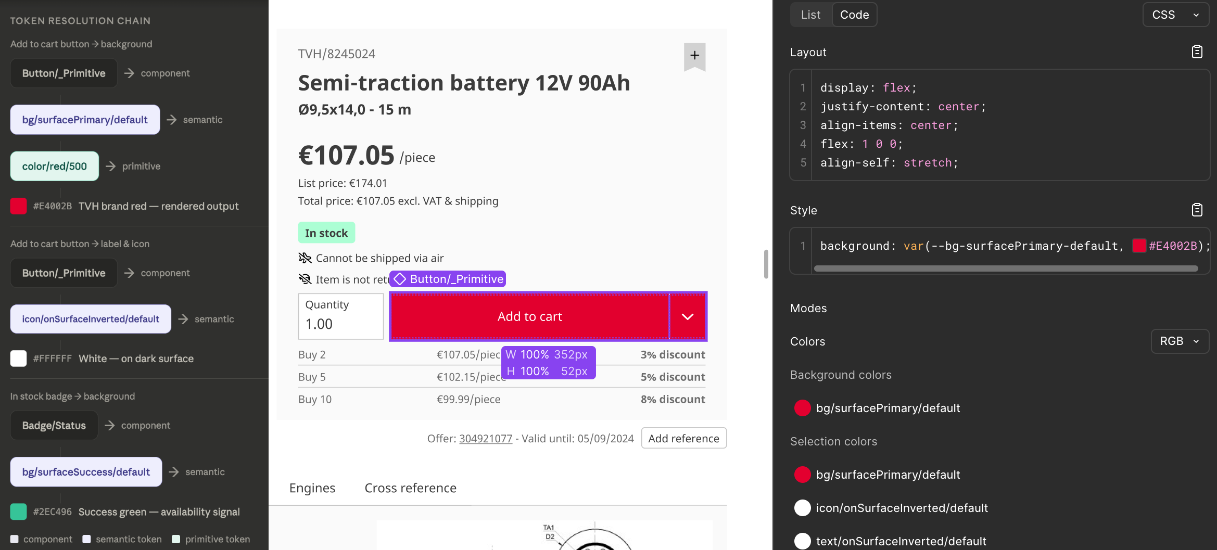 TVH Parts Co.
How moving design system engineers under UX ownership, then co-designing governance with an engineering advocate, turned a neglected component library into shared infrastructure across four brand tech teams.
At TVH, a design system existed in name only. Engineers had stopped trusting it and were building their own components. Moving DS engineers under UX and co-designing governance with an engineering advocate stabilized the system and expanded it to four brand tech teams and 15 front-end developers, with a token architecture that would underpin the company’s planned international brand consolidation.