
Format: Operating model · System
Uplift: Fixing the Org Before Fixing the Design System
Transforming a neglected component library into a shared language between design and engineering
TVH’s design system, Uplift, was used by one development team, largely without UX guidance. The engineers who maintained it sat in Development and lost their time to every tight product sprint, so teams stopped trusting it and built their own components.
- My part
- As Director of UX (Global UX Lead), I made the case to engineering leadership for moving the design system engineers under UX, co-designed governance with Jennifer Dennon, started the Tokens Studio setup, scoped Bitbucket, and selected the reference tools and Figma Dev Mode workflow. Conor Sixta migrated, refined, and completed the tokens and operated and completed governance.
- The team’s part
- At its largest, my team was 11: seven designers, a researcher, and three design system engineers. I hired Conor Sixta as DS Design Lead in August 2023, before the engineers moved under UX around mid-2024. Jennifer Dennon championed the move and co-designed governance with me.
- Status
- Internal
- Timeline
- Apr 2023 – Oct 2024 at TVH; Conor Sixta hired Aug 2023; DS engineers moved under UX around mid-2024
Outcome
By my October 2024 count, Uplift expanded from one team using it unguided to four brand tech teams and approximately 15 front-end developers.
Source account1
Tags & related work
The short version
Diagnose
Uplift was a real system, built on MUI with a Figma library, and one development team used it, mostly without UX guidance. The cause was structural. The engineers who maintained it sat in Development, and when a product sprint got tight they were reassigned. Bugs sat, Figma and code drifted, and teams learned that using Uplift added risk. So they built their own components.
Before, the engineers who maintained Uplift sat in Development. When a sprint got tight, their time went to product work, Figma and code drifted apart, and teams built their own components. Argue
The engineers moved under UX around mid-2024 after about six months of advocacy. Jennifer Dennon championed the move in a peer org where I had no authority. I argued quality and performance. Jennifer and I shaped contribution proposals, engineering review and approval, and documentation standards; Conor Sixta operated and completed governance. Protected capacity helped the repository stabilize.
Around mid-2024, the design system engineers moved under UX, protecting their capacity. Jennifer Dennon and I co-designed governance; Conor Sixta operated and completed it. Wire
I started the Tokens Studio setup and scoped Bitbucket as the JSON source of truth. Conor Sixta migrated the tokens from Figma Variables into git-managed JSON, then refined and completed the work. I selected Storybook for developers, Zeroheight for product and marketing, and the Figma Dev Mode workflow. Original technical artifacts have not been independently inspected.
I started the Tokens Studio setup and scoped Bitbucket. Conor Sixta moved the tokens into git-managed JSON and refined and completed the work. I selected Storybook and Zeroheight as reference tools. Extract
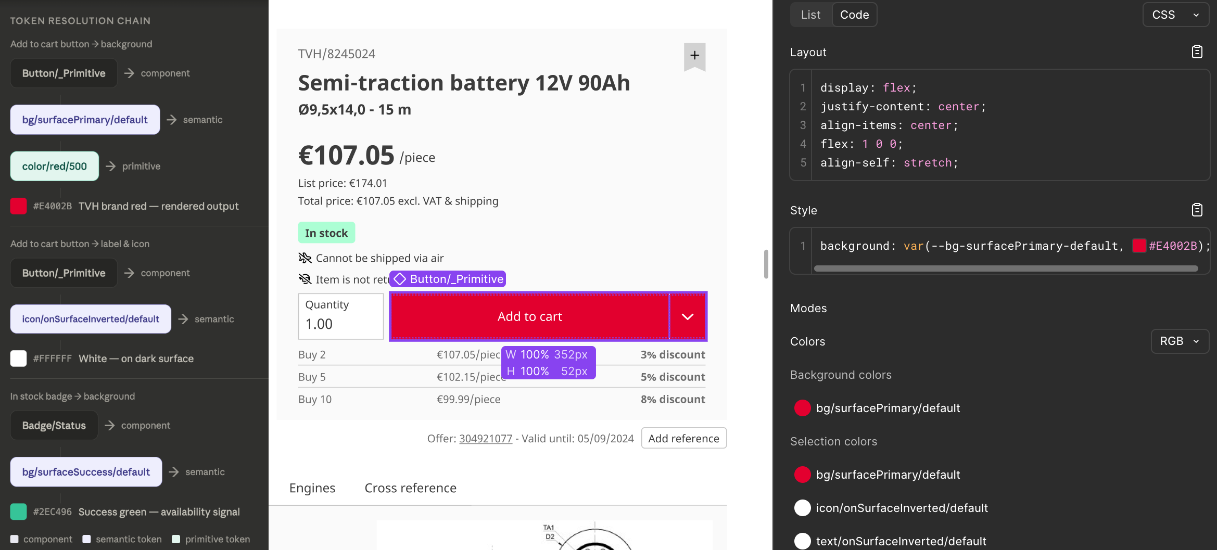
With stable tokens, developers stopped sampling colors with eyedroppers and estimating spacing. In Figma Dev Mode they read a token name instead of a hex value and took consistent CSS straight from the design file. The handoff still depended on designers finalizing and documenting designs before developers opened the file.
Figma Dev Mode with token names in place of hex values. Developers extracted CSS from the design file instead of sampling colors with an eyedropper. Spread
By my October 2024 count, Uplift reached approximately four brand tech teams, three primary and one secondary, and 15 front-end developers, up from one unguided team. These were internal adoption counts. Conor Sixta, hired in August 2023, carried the token and governance work; the system and cross-brand work were ongoing when I left.
By my own count in October 2024, Uplift reached approximately four brand tech teams and 15 front-end developers, up from one team using it mostly without UX guidance. These were internal adoption counts, not an independently audited census. Prove
The clearest proof was behind the screens. The Product Details Card, a monolithic component used on nearly every product page, was rebuilt as a configurable pattern, and Product signed off on the full rebuild. Historical team/JIRA reporting put documented pattern updates at approximately one sprint instead of three; original reports have not been independently inspected. Time saved per brand I can’t state, because the brands ran on different backends. Consolidation was a direction, not a commitment.
- Earlier design: eShop Neo
- Redesign: Innovatis
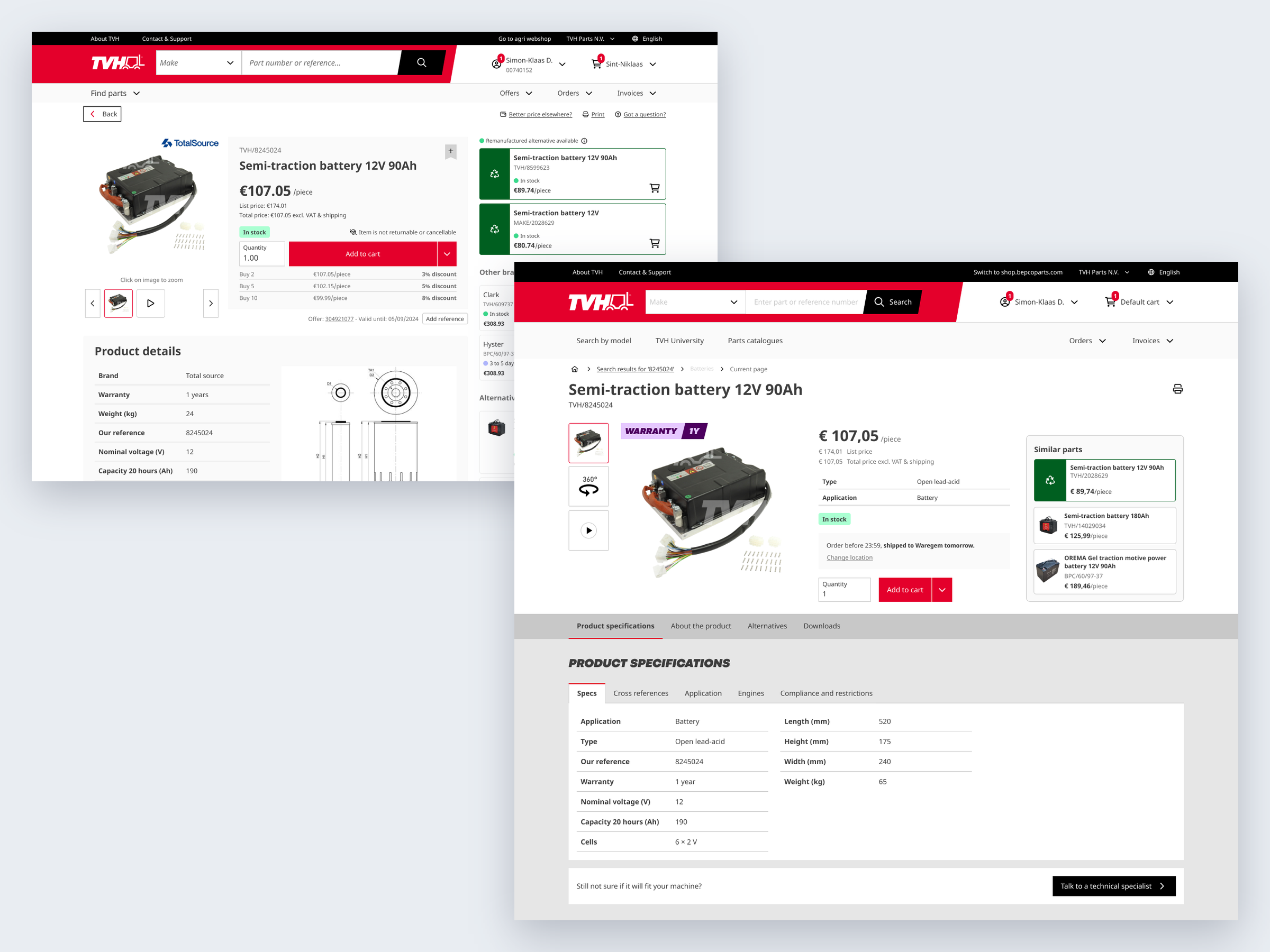
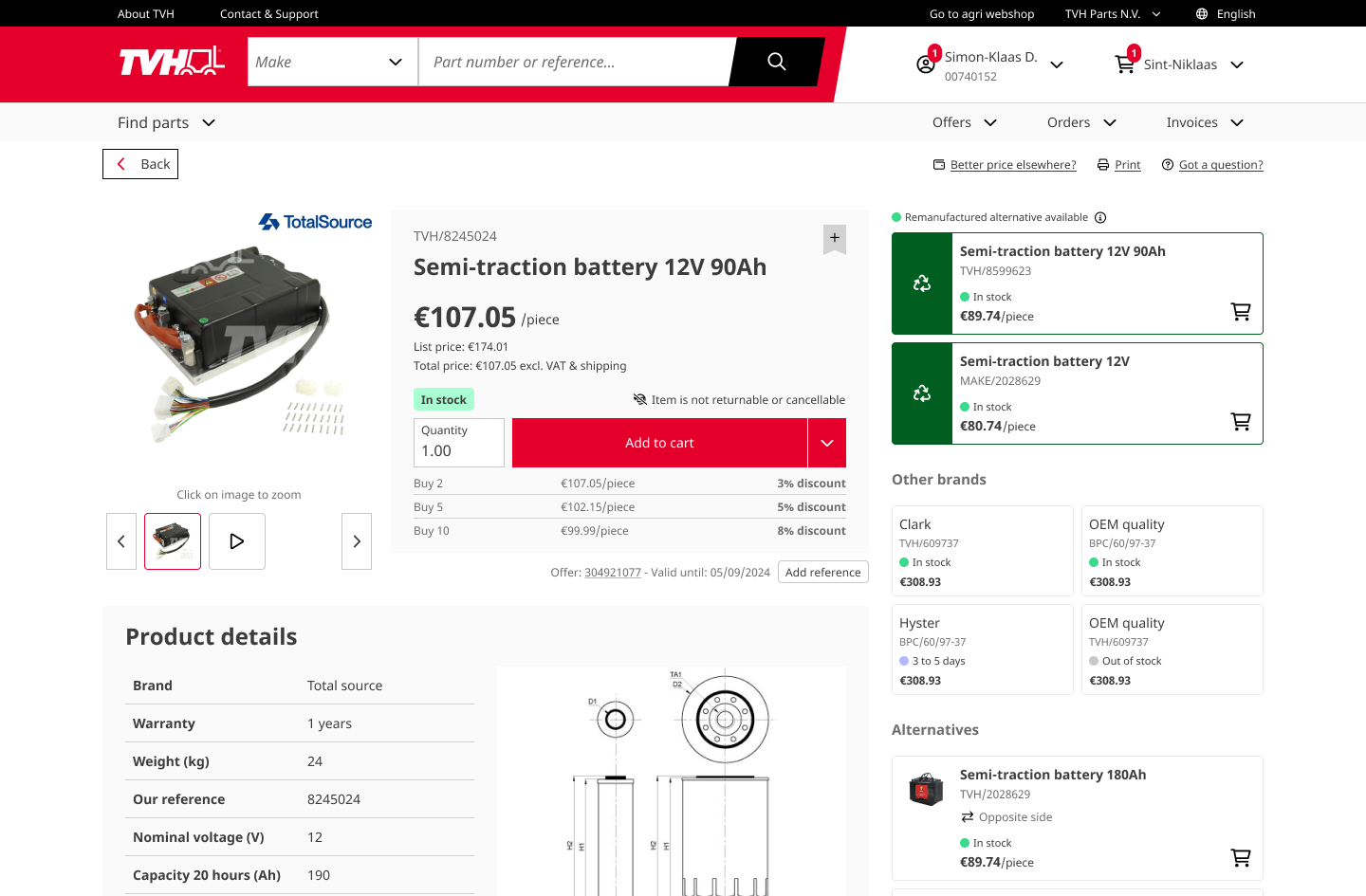
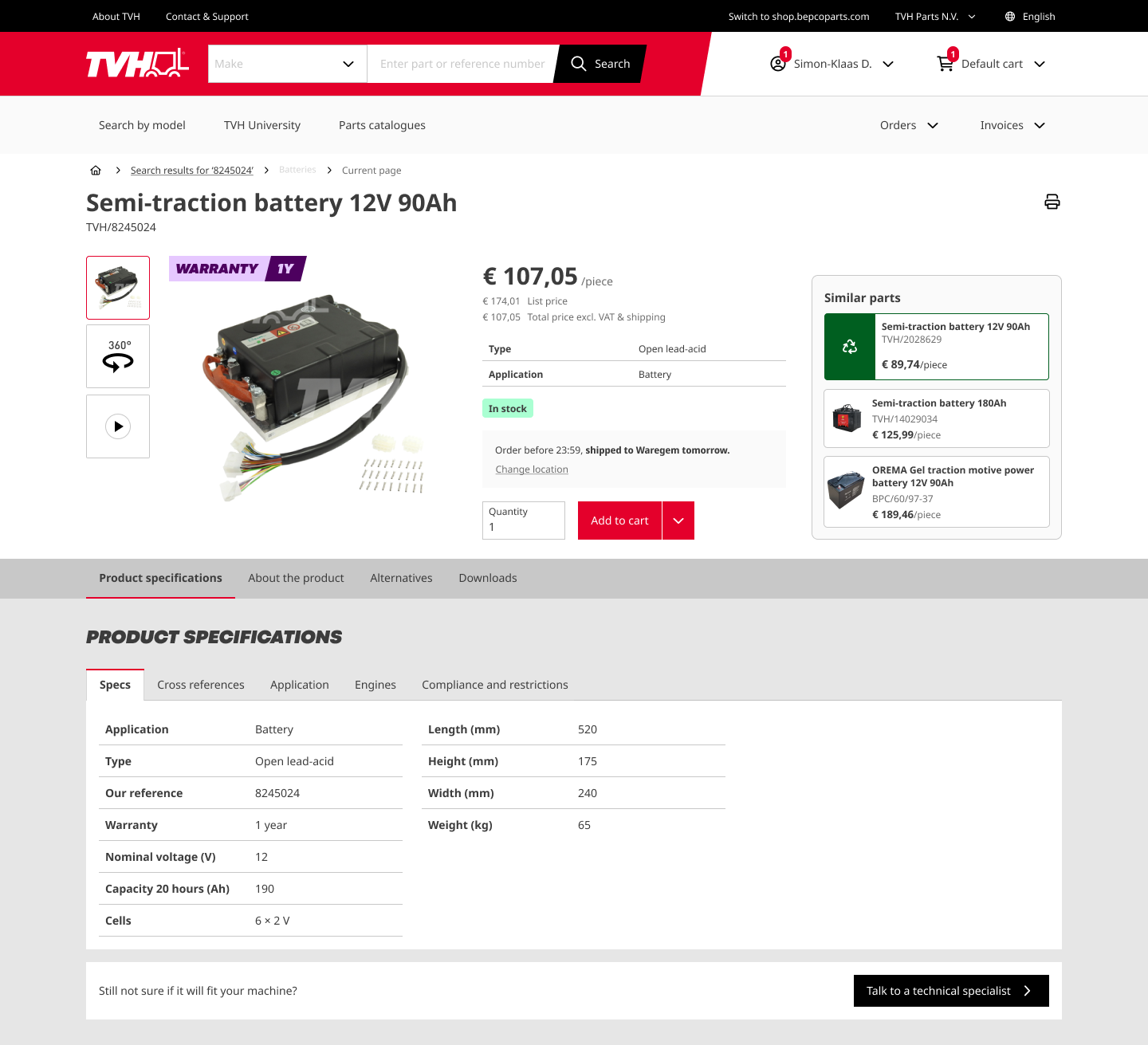
Design-file exports of the same part in eShop Neo and Innovatis. I contributed low/mid-fidelity specs/details tabs alongside Geoffrey Van Meirhaeghe and Suzan; Suzan finalized both displayed screens. I made the comparison composite. Innovatis and cross-brand work remained in progress at my October 2024 departure; these exports do not establish a customer release.
Decisions that mattered
Decision 1
Where should the design system engineers sit?
- Options
- Choice
- Move under UX, with capacity protected from product sprints
- Evidence
- In Development, their time lost to every tight product sprint, and the protection couldn’t be informal. It had to be organizational.
- What followed
- The repository stabilized almost immediately. It took about six months of advocacy in a peer organization to get there, and stability alone wasn’t enough to rebuild trust.
Decision 2
Who designs the governance model?
- Options
- Choice
- Co-design it with an engineering advocate
- Evidence
- Their pushback on how contribution workflows would meet engineering review, and on what “stable” meant to an engineer, made the model significantly stronger.
- What followed
- Other development teams saw engineering fingerprints on the model, and the conversation changed. The system had standing in tech because tech had helped shape it.
Decision 3
How should the multi-brand scope be handled?
- Options
- Choice
- Govern the primary brand first, and bring secondary brands in incrementally
- Evidence
- It was an honest read of capacity and leverage. Solving for all three at once would have diluted the effort enough to stall trust recovery on the primary product.
- What followed
- By my October 2024 count, approximately four brand tech teams were using Uplift, three primary and one secondary. Time saved per brand can’t be stated cleanly, because the brands ran on different backends and page layouts.
Decision 4
Where should the design tokens live?
- Options
- Choice
- Move to a git-managed JSON file that Tokens Studio consumes
- Evidence
- In Figma Variables the tokens were tool-locked and invisible to version control.
- What followed
- A token change became versioned and reviewable like any other code change, and Figma and the codebase fed from the same source. With Figma Dev Mode, developers extracted CSS instead of sampling it by eye.
What I’d do differently
The six months went mostly to finding an engineering advocate, and what broke the idea open was that leader pushing back on how I planned to run governance. I would bring engineering into the design of the model from the first conversation rather than after I had a plan. I still can’t put a per-brand time saving on the template work, and the consolidation it was built for was a direction the company hadn’t fully committed to when I left.
Results
- Tech team adoption4 brand tech teamsfrom 1 team using the system unguided, by my own October 2024 count
- Front-end developers reached15 developersapproximately, across 3 primary brand teams + 1 secondary brand team, by my October 2024 count
- CSS accuracyToken-extracted CSSfrom eyedropper guesswork to consistent values via Figma Dev Mode
- Org advocacyDS engineers under UXafter ~6 months of cross-org advocacy in a peer organization
- Product Details Page delivery3 sprints → 1 sprintReported in historical team/JIRA data for documented pattern updates after the Product Details Card rebuild; original reports not independently inspected
PDP design work
Earlier eShop Neo design-file export, with price, stock, and add to cart stacked in one narrow column. Suzan finalized this collaboratively designed screen.
Innovatis design-file export, where price leads, then the facts a buyer checks, stock and the delivery promise. Suzan finalized this collaboratively designed screen; the redesign and cross-brand work remained in progress when I left in October 2024.
Read the full story7 min
The moment it clicked
There’s a pattern I’ve learned to recognize. You ask a developer why they built a custom component instead of using the design system, and the answer is vague: “it was faster to just build it.” What they almost never say is: I stopped trusting it.
That was TVH when I arrived. Uplift was a real, thoughtfully built system on MUI with a Figma component library. But when I looked at what ran in production, I kept finding components that didn’t exist in the library. Only one development team used the coded system at all, and even they used it largely without UX guidance.
TVH is a multi-brand, international operation: the main TVH brand serving western Europe, TVH America covering North America, and Bepco, primarily agricultural and based in France. The company’s direction was a cautious consolidation toward a single platform for buying industrial parts. That made the design system the foundation for a major strategic move, and right now one team used it, inconsistently.
The diagnosis
The cause was structural. Not design quality, not documentation, not communication. Capacity.
Design system engineers sat inside the Development organization. When a product sprint got tight, and product sprints always get tight, the design system work lost. The engineers meant to maintain Uplift’s repository, fix bugs, and keep the Figma library in sync with production code were reassigned, consistently. Nothing protected that capacity.
The drift ran in both directions. Without reliable design tokens, developers used eyedroppers to sample colors and estimated spacing values. And decisions made during delivery rarely traveled back to design, so the Figma library collected manual variations that approximated what the codebase had become instead of representing it. Teams found the drift when it hurt delivery, concluded, correctly, that using Uplift added risk, and stopped.
That protection couldn’t be informal. It had to be organizational.
The argument
My case to engineering leadership was that the design system isn’t a development project that occasionally needs UX input. It is a UX project that happens to produce code, so its health is a design concern before it is a delivery concern. I made it in the terms tech leadership measured, quality and performance. A system teams had opted out of produced subtle inconsistency and translation drift, and every custom component built outside it was engineering time that didn’t need to be spent.
The deeper argument was strategic. The ecommerce sites were already being templatized across brands, with distinct identities kept through token-driven theming, and that only worked if the design system was mature enough to carry it. I pushed to mature Uplift quickly because the window wasn’t unlimited.
Building credibility
I hired Conor Sixta as DS Design Lead in August 2023. He carried the token and governance work well before the engineers moved under UX around mid-2024.
Getting the DS engineers to report through me took about six months, and most of that wasn’t spent arguing. It was spent finding the right person to argue with. TVH has a large, mature tech organization, I led a peer org, and UX didn’t traditionally have front-end engineers on its teams. The risk wasn’t a no. It was that the idea would sit politely in a queue.
What broke it open was Engineering Director Jennifer Dennon, who understood what I was trying to do and championed it internally. Then something more valuable happened: she pushed back on how I was planning to run it. Her feedback on how contribution workflows would meet engineering review, and on what “stable” meant to an engineer, made the model significantly stronger. It wasn’t a governance process designed by UX and handed to engineers. It was stress-tested by someone who understood both sides, and when other development teams saw that engineering fingerprints were on it, the conversation changed.
Once the engineers were under UX, the repository stabilized almost immediately. That was the straightforward result of protected capacity, insulated from product delivery reprioritization. Stability wasn’t enough to rebuild trust, though. Teams needed a way to participate in the system rather than just consume it, so governance had three parts: a contribution model that let product teams propose components, engineering review and approval before anything shipped to the shared library, and documentation standards that made the system navigable for designers and engineers. Jennifer and I shaped that model; Conor took it over, ran it, and completed it.
The DS Dev team also ran two-week sprints that it scoped and timelined itself in JIRA. Priority went to bugs found by design or QA, revisions to existing patterns, and new patterns for active redesigns. The team that owned the system also owned what it worked on next.
One source, several audiences
The tokens had lived inside Figma Variables, tool-locked and invisible to version control. I started the Tokens Studio setup and scoped Bitbucket as the JSON source of truth. Conor migrated the tokens into a git-managed JSON file that Tokens Studio consumed and manipulated, so a token change was versioned and reviewable like any other code change, and Figma and the codebase fed from the same source. Conor refined and completed the token work. I selected Storybook as the developer reference, living documentation of components in their coded state. Zeroheight gave product, marketing, and other teams a readable reference without opening a repository, and marketing used it to design non-ecommerce sites directly, which extended Uplift’s reach without creating a parallel system. Figma Libraries served UX design. I also selected Zeroheight and the Figma Dev Mode workflow. Original Figma, Bitbucket, and token-governance artifacts have not been independently inspected.
The multi-brand challenge was handled through scoping: the primary brand governed and stable first, secondary brands documented with a clear path into the system incrementally. Solving all three at once would have diluted the effort enough to stall the trust recovery on the primary product.
What teams were using
By my own count when I left TVH in October 2024, Uplift had gone from one development team using the coded system, mostly without UX guidance, to approximately four brand tech teams: three primary and one secondary. That covered approximately 15 front-end developers. These are my historical internal adoption counts, not an independently audited census or evidence of a completed cross-brand customer platform.
The token architecture was probably the most concrete day-to-day improvement for developers. Before stable tokens, they sampled colors from design files with eyedroppers and estimated spacing, and that compounded across hundreds of components into inconsistency no single person caused. With mature tokens and Figma Dev Mode, developers could extract consistent CSS directly from the design file. The guesswork left the process.
The clearest proof of adoption wasn’t new UI. Most of what changed looked no different. The Product Details Card, a monolithic, hard-to-extend component used across nearly every product page, was rebuilt as a reusable, configurable pattern, for two reasons at once: current performance metrics and the expansion the roadmap already called for. It became the largest single acceptance the governance model produced, a full rebuild that Product signed off on rather than routed around. Historical team/JIRA reporting put documented pattern updates at approximately one sprint instead of three, after the pattern answered questions that used to go back and forth in tickets. Original reports have not been independently inspected, and the figure does not describe whole-system delivery or time to release Innovatis.
I also contributed directly to the PDP design while leading it, working on low- and mid-fidelity product specs/details tabs alongside Geoffrey Van Meirhaeghe and Suzan. Suzan finalized both displayed eShop Neo and Innovatis screens. I made the comparison composite from design-file exports; these are not authenticated production captures. The Innovatis redesign and cross-brand templating I led remained in progress when I left in October 2024.
- Earlier design: eShop Neo
- Redesign: Innovatis
How much time the template saved per brand is hard to state cleanly. TVH, TVH America, and Bepco ran on different data backends with different page layouts, so extending the template wasn’t a like-for-like copy job. What’s true instead is qualitative: each brand’s build started from a common token and component foundation rather than from nothing. TVH’s direction was consolidation, but the process was cautious, and three brand experiences were not going to merge overnight.
Across the broader UX organization, my team reached a maximum of 11: seven designers, a researcher, and three design system engineers. That was its largest composition, not a constant staffing level. Conor’s August 2023 hire gave Uplift dedicated design leadership early; the hire itself was not evidence that the system was stable or fully adopted, and system work remained ongoing during my tenure.
The larger argument
The lesson I’d take from Uplift to any organization with a struggling design system: before you invest in better documentation, tooling, or design quality, ask where the engineers are. Not which engineers. Where they sit, who sets their priorities, and what happens to their backlog when a product sprint gets tight.
A design system is infrastructure, and infrastructure needs protected maintenance capacity. When that capacity is embedded in a delivery organization, it loses to delivery pressure, not because anyone made a bad decision but because delivery pressure is immediate and visible in ways infrastructure debt isn’t. The system I inherited wasn’t bad work. It was good work that had been structurally set up to fail, and fixing it meant fixing the structure first.
The strategic part is what I find most interesting in retrospect. Consolidating three international brands into one platform isn’t primarily a technology challenge. It’s a design language challenge, and the work was building the foundation for a move the company hadn’t fully committed to making yet.
Team
- 3 design system engineers
- 7 designers, including Conor Sixta, hired as DS Design Lead in August 2023 (international)
- 1 researcher
My Contributions
- Cross-org structural argument to move DS engineers under UX
- Co-designed governance with Jennifer Dennon: contribution proposals, engineering review and approval, documentation standards; Conor Sixta operated and completed it
- Started Tokens Studio setup and scoped Bitbucket; Conor Sixta migrated, refined, and completed the token work
- Selected Storybook, Zeroheight, and the Figma Dev Mode workflow
- Hired Conor Sixta as DS Design Lead in August 2023
- Led cross-brand ecommerce templating across TVH, TVH America, and Bepco; in progress at departure
Tools
- MUI
- Figma
- Figma Libraries
- Figma Dev Mode
- Tokens Studio
- Storybook
- Zeroheight
- Design tokens
- CSS token systems
Source account
The numbered notes are the records behind the statements marked in the page above.
This selected retrospective account is separate from the authored story. It does not establish every claim, artifact credit, release status or image permission on this page.
Jason started and led Uplift’s initial token setup using Tokens Studio in Figma and scoped Bitbucket as the location for the JSON source of truth.
Scope: Conor Sixta, whom Jason hired to take over design-system leadership, later refined and completed the token work and established its governance. Initial setup/scoping is not sole implementation of the completed system or every integration. Original Figma, Bitbucket and token-governance artifacts remain uninspected.
Account context and references
Attribution: Jason Sonderman. Jason started and led Uplift’s initial token setup using Tokens Studio in Figma and scoped Bitbucket as the location for the JSON source of truth. Conor Sixta, whom Jason hired to take over design-system leadership, later refined and completed the token work and established its governance. Initial setup/scoping is not sole implementation of the completed system or every integration. Original Figma, Bitbucket and token-governance artifacts remain uninspected.
Project scope: scope: Curated account excerpt; not the full legacy page, raw evidence or an independently audited outcome.
Selected profile: Jason Sonderman. scope: Scoped professional account; no unreviewed employment titles, tenure, credentials or contact fields.
Work context: TVH Parts Co.: Design-system strategy, shared governance and UX team leadership. scope: Scoped work description, not a confirmed employment title or employment period. scope: Jason co-designed Uplift governance with Engineering Director Jennifer Dennon, who advocated and sponsored the engineer reporting-line move.
Capability association: Design-system token strategy: Start token architecture/toolchain work and enable subsequent dedicated ownership. Editorial association with the selected historically confirmed activity; not a verified proficiency score. scope: Jason initial setup/scoping; Conor later completion/governance. Not sole author of all integrations.
Evidence account: Jason Sonderman. Jason started and led Uplift’s initial token setup using Tokens Studio in Figma and scoped Bitbucket as the location for the JSON source of truth. scope: Not sole completed-system implementation; artifacts/pipeline not inspected. Jason reports directly contributing to TVH Product Detail Page design while serving in design leadership, collaborating with two other designers. This retrospective account does not establish sole PDP authorship, individual artifact-level responsibilities, or independent verification of PDP design contributions. uncertainty: Support assessment proposed for this selected statement only; original employer artifact/report not independently inspected. No image or diagram supplied.
Source availability: Jason Sonderman retrospective account, with the required statement-specific limitations. uncertainty: Retrospective account; original employer records not independently inspected. Private source material is not provided by this API. Original source URL: not publicly available.
- Profile: pro_jason, revision 1; selected context: exp_tvh; selected capability: cap_systems.
- Project: prj_uplift, revision 1; experience: exp_tvh, revision 1; capability: cap_systems, revision 1.
- Assertion: UP-TV-04, revision 1; kind: personal_contribution_with_shared_scope; attribution scope: shared_or_distinct_collaborator_credit_required; verification: historically_confirmed_not_independently_verified.
- Evidence: evd_upliftaccount, revision 2; kind: account; support assessment: supports; supports: UP-TV-04; attribution scope: qualified_retrospective_account.
- Capability link: UP-TV-04, evd_upliftaccount, editorial_association.
- Source: src_upliftaccount, revision 1; kind: account; availability: not_publicly_available; public_url: null.
- Projection revision: r_308df1f9adbeed62267e5b45121f995135dc496c94de715497f225092b3192e4.
Agent view
This page has a machine-readable twin, generated from the same source rather than written alongside it.
See how an agent reads this page